
Skip to content
Choose your language:
  • There are no suggestions because the search field is empty.
Take Your Free
Assessment

Figure out if you qualify...

Take The Free Immigration Assessment

Meet with one of our immigration consultants

Book An Appointment

    CANADIAN CITIZENSHIP BY DESCENT

    Confirm Your Canadian Citizenship by Descent With CanDo Immigration

    Born outside Canada to a Canadian parent, grandparent, or other Canadian ancestor? Learn how Canadian citizenship by descent works under the current rules, what changed when Bill C-3 ended the first-generation limit, and how CanDo's regulated consultants help you gather the evidence Immigration, Refugees and Citizenship Canada (IRCC) needs for a Canadian citizenship certificate.

    2025 winner badgeCanDo Platinum Badge

    Regulated Canadian Immigration Consultants (RCIC-IRB)

    Proudly regulated by and in good standing with the College of Immigration and Citizenship Consultants (CICC). Jamie Dowla, registration #: R507233.
    Regulated-Canadian-Immigration-Consultants-section-image-v3

    What Is Canadian Citizenship by Descent?

    Canadian citizenship by descent means you may already be a Canadian citizen because a parent, grandparent, or other Canadian ancestor passed their citizenship to you at birth, even though you were born outside Canada. Unlike a permanent resident applying for citizenship, you don't take a citizenship test or attend a ceremony. Most people in this position instead apply for a Canadian citizenship certificate, the document that proves the citizenship you already hold.

    Whether you qualify depends on the "first generation limit" set out in the Citizenship Act, a rule Bill C-3 significantly narrowed. The rules below explain exactly how the current first-generation limit applies to your situation.

    CanDo Immigration's regulated Canadian immigration consultants review your family's immigration and citizenship history, confirm which rules apply to you, and help you gather the documentary evidence Immigration, Refugees and Citizenship Canada requires before you apply for proof of citizenship.

    LEARN MORE ABOUT CANADIAN CITIZENSHIP

    What Is Canadian Citizenship by Descent image

    Canadian Citizenship By Descent Eligibility

    Whether you're a citizen by descent and whether you can pass citizenship to your own children born abroad depends on your generation and, for births on or after December 15, 2025, on your Canadian parents' own connection to Canada.

    People Born Before December 15, 2025

    If you were born outside Canada before December 15, 2025, and your parent was a Canadian citizen when you were born, you're likely already a Canadian citizen, with no application required to maintain Canadian citizenship status.

    This now includes people who the first-generation limit previously excluded. If your Canadian parent was born or naturalized outside Canada, making you second-generation or later, the end of the first-generation limit means you're automatically a citizen, with no application needed to hold that legal status.

    People Born On or After December 15, 2025

    If you were born on or after December 15, 2025, your eligibility depends on IRCC's substantial connection test. The substantial connection test determines whether your Canadian parent had spent enough time physically present in Canada to establish a real connection to the country before you were born. If your Canadian parent was born or naturalized in Canada, you're a citizen by descent with no further test required. If your Canadian parent was also born outside Canada, making you second-generation or later, the test comes down to a number: that parent must have been physically present in Canada for a cumulative 1,095 days before your birth for you to be automatically a citizen. Those days don't need to be consecutive.

    People Adopted Outside Canada

    A person adopted abroad by a Canadian citizen parent can also become a citizen by descent, provided the adoptive parent held Canadian citizenship at the time of the adoption. The first-generation limit still restricts some adoptions. If the adoptive parent was themselves born abroad to a Canadian citizen, or became a citizen through adoption, the child generally can't be adopted into citizenship unless the parent, or for a further generation the grandparent, was employed abroad by the Canadian Armed Forces, the federal public administration, or a provincial or territorial public service at the time. Citizenship-by-adoption applications are submitted in two parts, one confirming the adoptive parent's citizenship and one covering the child, to IRCC's case processing centre in Sydney, Nova Scotia.

    Proving Your Canadian Citizenship by Descent

    Because citizenship by descent isn't granted through an application, most people in this position are proving the citizenship they already hold, usually to get a Canadian passport or access other government services. That puts the focus on documentary evidence rather than a test or an interview.

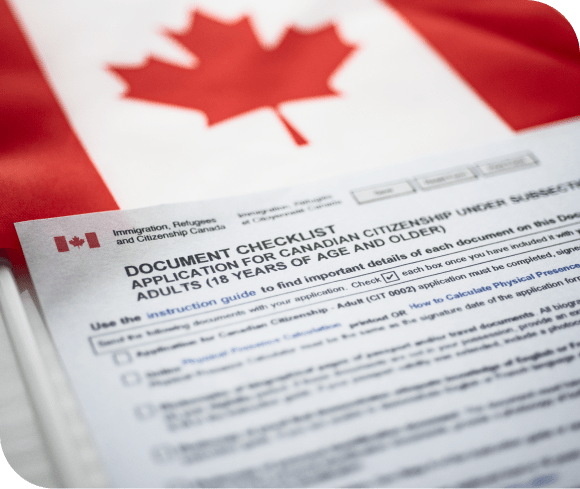
    Documents You'll Need

    To prove your Canadian parent, grandparent, or other ancestor's citizenship, IRCC generally asks for documents issued by the original authority, including:

    • A provincial or territorial birth certificate
    • A Canadian citizenship or naturalization certificate
    • A Certificate of Registration of Birth Abroad or Certificate of Retention of Canadian Citizenship
    • Proof of British subject status before January 1, 1947 (April 1, 1949 for Newfoundland and Labrador)
    • Proof of landed immigrant status before those dates
    Documents You_ll Need-image

    When Standard Documents Aren't Available

    Older or harder-to-trace family lines, such as a great-grandparent's birth abroad, don't always come with a surviving birth or marriage certificate. If a standard Canadian lineage documentation isn't available, IRCC asks you to explain in writing why you can't obtain it and to show proof of your attempts, such as a rejection letter from the issuing authority. From there, alternative evidence from an original source can support your application, including:

    • Hospital birth records
    • A record from a physician or midwife who witnessed the birth
    • A baptismal certificate, if it was completed within a reasonable time after the birth
    • Census records
    • Boat manifests
    When Standard Documents Aren_t Available-image

    IRCC is clear that an application can't be supported by third-party records alone, a genealogy website summary, or a family tree, for example, without an original-source document behind it. CanDo's consultants review what you already have, identify the gaps, and help you gather alternative evidence that will actually hold up.

    The Canadian Citizenship by Descent Application Process

    CanDo Immigration helps you demonstrate eligibility for Canadian citizenship by descent and prepare a complete application for a citizenship certificate.

    01

    Confirm your eligibility.

    Determine your generation and, if you were born on or after December 15, 2025, whether at least one parent meets the substantial connection requirement.

    02

    Gather your documentary evidence.

    Collect birth, citizenship, and immigration records for yourself and your Canadian parent, grandparent, or ancestor. If a standard document isn't available, start building your alternative evidence early.

    03

    Complete your citizenship certificate application.

    Most adults and minors apply using form CIT 0001 to request proof of citizenship under section 3 of the Citizenship Act.

    04

    Submit your application to IRCC.

    Applications and supporting documents are submitted along with the applicable government fee.

    05

    Respond to any requests for more information.

    IRCC may ask for additional documents or clarification while your file is under review.

    06

    Receive your Certificate of Canadian Citizenship.

    Your certificate is your proof of citizenship, and the document you'll need to apply for a Canadian passport or access other government services.

    Testimonials

    Success Stories From Our Canadian Immigration Clients

    explore

    Learn About All of the Great Things
    Canada Has to Offer!

    why us

    How CanDo Supports Your Canadian Citizenship by Descent Case

    CanDo Immigration has spent over 35 years helping people confirm their Canadian citizenship and prepare the documentation that IRCC requires, including cases spanning multiple generations.

    35+ Years Reviewing Citizenship and Immigration Files

    For over three decades, CanDo Immigration has helped clients apply for canadian citizenship by descent through complex family histories, not just straightforward first-generation cases. 

    We Trace Eligibility Through Every Generation

    Our consultants review your family's citizenship history generation by generation, so you know exactly which rules apply to you and whether the substantial connection test affects your own children.

    We Help You Build Evidence IRCC Will Accept

    When a birth or marriage certificate isn't available, we help you identify and gather the alternative evidence, from baptismal records to census documents, that IRCC's original-source requirement calls for.

    Support From Application to Certificate

    We stay involved after you submit your application, helping you respond to IRCC requests until your certificate of Canadian citizenship is in hand.

    BLOGS

    Canadian Immigration News, Tips, and Resources

    Group of Smiling Working Full Time Student in Canada
    Dec 18, 2025

    Can International Students Work Full Time in Canada? Understanding the Rules for Off-Campus Work

    Studying in Canada opens doors to world-class education, exciting career opportunities, and a vibrant multicultural experience. For many international students, working while studying is a crucial

    read more
    smilig student holding the Canada Flag
    Nov 21, 2025

    How to Get Permanent Residency in Canada After Study: Pathways for International Graduates

    For many international students, studying in Canada is the first step toward building a life in one of the most welcoming and diverse countries in the world. From high-quality education to strong job

    read more

    Workers wearing hard hats, chatting to each other while working in a Canadian factory.
    Aug 6, 2025

    What is LMIA in Canada: An Overview for Canadian Employers

    If you're a Canadian employer planning to hire a foreign worker, you'll need to navigate the Labour Market Impact Assessment (LMIA) process. This crucial step helps ensure that hiring a foreign

    read more

    View More Blog Posts
    LOCATIONS

    Find Your Dedicated Immigration Consultant Wherever You Are 

    We assist clients worldwide with their applications. See the cities below to find your regulated Canadian immigration consultant.

    Frequently Asked Questions

    What changed with the Canadian Citizenship by Descent bill?

    Before December 15, 2025, a rule known as the first-generation limit, in place since 2009, generally prevented Canadians born outside Canada from passing citizenship to their children born abroad. The Ontario Superior Court of Justice ruled in December 2023 that the limit was unconstitutional, and Bill C-3 changed the Citizenship Act to end it. Anyone born outside Canada before December 15, 2025, to a Canadian parent is now a citizen regardless of generation. Anyone born on or after that date needs their Canadian parent to meet a substantial connection test if that parent was also born outside Canada.

    How long does it take to get a citizenship certificate?

    Processing times for proof of citizenship applications vary and can run considerably longer than IRCC's standard citizenship grant timelines, since your application also has to be reviewed against the current eligibility rules and any supporting evidence you've submitted. IRCC updates its processing time estimates monthly based on current application volume, so check IRCC's live processing times tool for citizenship certificates before you apply. CanDo's consultants can help you understand what's realistic for your specific situation.

    Can I request urgent processing for my citizenship certificate?

    In limited circumstances, yes. IRCC will consider urgent processing requests for situations like a family emergency requiring travel, a time-sensitive job or school requirement, access to social benefits, moving a minor child to Canada, statelessness, or protection from harm. A request needs a written explanation and supporting documents, such as a flight itinerary or a letter from an employer or school. Even a qualifying request isn't a guarantee your certificate will arrive in time, so it's worth applying as early as possible rather than counting on an urgent request later.

    Can I pass Canadian citizenship to my own children born abroad?

    It depends on your generation and, for a child born on or after December 15, 2025, whether you meet the substantial connection test. If you were born in Canada or naturalized in Canada, there's no day-count requirement for your children. If you were born outside Canada, you'll need to have accumulated 1,095 days of physical presence in Canada before your child's birth.

    Can Americans or other non-Canadians claim Canadian citizenship through a Canadian parent or grandparent?

    Possibly. Many people living outside Canada, including in the United States, are already Canadian citizens through a Canadian-born parent or grandparent and don't realize it until they look into their family history. CanDo's consultants can review your specific family line against the current rules and help you confirm whether you already hold citizenship or could apply for it.

    I'm a British subject. Could that make me eligible for Canadian citizenship by descent?

    It depends on whether that status has a Canadian connection. Canada's Citizenship Act didn't exist until January 1, 1947 (April 1, 1949 for Newfoundland and Labrador), so anyone born, naturalized, or already living in Canada before then held British subject status rather than Canadian citizenship as it's understood today, and that status generally converted into Canadian citizenship once the Act took effect. Being a British subject on its own, without ties to Canada specifically, doesn't establish Canadian citizenship. If it's an ancestor's status from that era you're working from, IRCC accepts proof of their British subject status in Canada, or their landed immigrant status before that date, in place of a citizenship certificate that didn't yet exist. CanDo's consultants can review your specific family line and confirm whether it supports a claim to citizenship by descent.

    Does it matter how many generations back my Canadian ancestor is?

    It can. Bill C-3 removed the old fixed limit on how many generations citizenship by descent could pass through, but your eligibility is still assessed through your immediate Canadian parent's own citizenship status, not directly through a more distant ancestor. Tracing eligibility back to a great-grandparent or another distant Canadian ancestor usually means checking each generation in between against the rules that applied when they were born, since the Citizenship Act has changed more than once. Because that can get complicated fast, this is exactly the kind of situation that CanDo's consultants review on a case-by-case basis. Get in touch for a free assessment of your specific family line.

    What's the difference between citizenship by descent and becoming a citizen through permanent residence?

    Citizenship by descent applies if you were born outside Canada to a Canadian parent, grandparent, or other Canadian ancestor. If you qualify, you're already a citizen and simply need a certificate of Canadian citizenship as proof, with no physical presence requirement, citizenship test, or ceremony. Becoming a citizen through permanent residence is a different path: you first need to hold permanent resident status, then meet the physical presence, tax filing, and language and testing requirements before applying for a citizenship grant, which includes a test and ceremony. If you're a permanent resident working toward citizenship instead, see our Canadian citizenship after PR page for the requirements that apply to you.